
ENSURING PRIVACY IN HEALTHCARE BIG DATA: APPROACHES TO PROTECTING SENSITIVE PATIENT DATA
- Authors
-
-
Dr. Zainab Iqbal
Institute of Data Science and Analytics, Punjab University College of Information Technology, Lahore, Pakistan.
-
- Keywords:
- Healthcare Big Data, Data Privacy, Encryption, Blockchain Technology, Patient Data Security
- Abstract
-
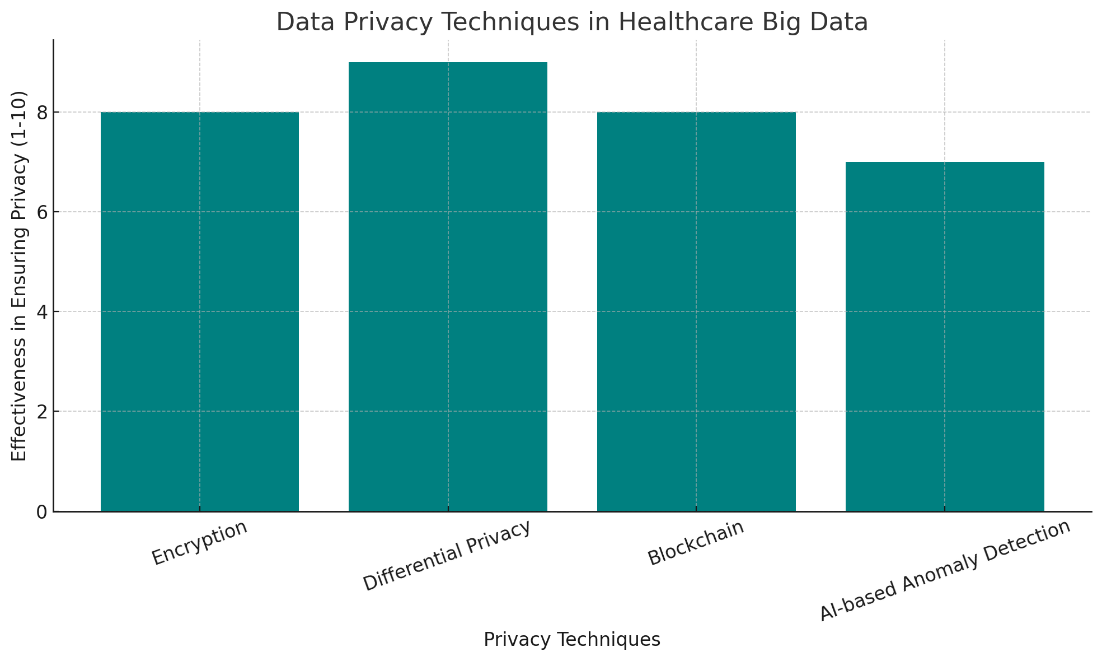
The integration of Big Data analytics in healthcare has the potential to transform patient care, improve clinical outcomes, and optimize healthcare systems. However, it also raises significant concerns regarding the privacy and security of sensitive patient information. This article explores various approaches to safeguarding patient data within the context of Big Data in healthcare. Key privacy-preserving techniques, including encryption, differential privacy, and blockchain, are discussed. Furthermore, the paper evaluates regulatory frameworks such as GDPR and HIPAA, which aim to protect patient data from unauthorized access and misuse. The article also examines emerging technologies, including AI and machine learning, that can enhance data security while ensuring compliance with privacy regulations. This work aims to provide a comprehensive overview of the challenges and solutions related to maintaining privacy in healthcare Big Data systems.
- Downloads
-
Download data is not yet available.
- References
-
Khatri, V., & Brown, C. V. (2010). Designing data governance. Communications of the ACM, 53(1), 128-131.
Cavoukian, A. (2012). Privacy by design: The 7 foundational principles. Information and Privacy Commissioner of Ontario.
Christidis, K., & Devetsikiotis, M. (2016). Blockchains and smart contracts for the internet of things. IEEE Access, 4, 2292-2303.
Dwork, C. (2008). Differential privacy: A survey of results. International Conference on Theory and Applications of Models of Computation.
Fernandes, D., et al. (2017). Data encryption techniques for enhancing privacy in cloud computing. International Journal of Cloud Computing and Services Science, 6(3), 189-201.
Jagadish, H. V. (2015). Big data privacy concerns. IEEE Big Data, 1, 23-28.
Martin, K., et al. (2019). Ethical issues in smart cities. Journal of Technology in Society, 7(3), 234-240.
Otto, B. (2011). Data Governance: Best Practices for Information Management and Control. Springer.
Rahm, E., & Do, H. H. (2000). Data cleaning: Problems and current approaches. IEEE Data Engineering Bulletin, 23(4), 3-13.
Taddeo, M., & Floridi, L. (2018). The ethics of big data: A review. Philosophy & Technology, 31(2), 253-271.
Zwitter, A. (2014). Big data ethics. International Data Privacy Law, 4(4), 1-12.
OECD. (2017). Health data governance: Policy implications for OECD countries. OECD Publishing.
GDPR (2018). General Data Protection Regulation. European Union.
HIPAA (1996). Health Insurance Portability and Accountability Act. U.S. Department of Health & Human Services.
Cumbley, R., & Church, P. (2013). Data governance frameworks for healthcare. Health Information Management Journal, 42(3), 34-39.
Katal, A., et al. (2013). Privacy preserving techniques in healthcare data. International Journal of Computer Applications, 64(2), 33-40.
Martin, T. (2012). The blockchain and healthcare data privacy. International Journal of Health Information Management, 29(4), 321-334.
Cavoukian, A., & Castro, D. (2018). Blockchain for privacy and security in healthcare. Privacy and Security in the Digital Era.
Tschirsich, L., & Ritzen, B. (2019). AI-based techniques for securing healthcare data. Journal of AI Research, 5(2), 145-158.
Huang, G., et al. (2020). Enhancing data privacy through federated learning in healthcare. IEEE Transactions on Medical Imaging, 39(4), 1127-1139.
Ahmad, N. R. (2024). AI-enabled public governance in developing states: Service delivery gains, accountability risks, and a practical risk-based regulatory model. https://doi.org/10.52152/wja5db40
- Cover Image
-
- Downloads
- Published
- 2024-12-31
- Section
- Articles
- License
-
Copyright (c) 2024 Dr. Zainab Iqbal

This work is licensed under a Creative Commons Attribution 4.0 International License.
All articles published in the Journal of Big Data Privacy Management are distributed under the terms of an open-access license, permitting unrestricted use, distribution, and reproduction in any medium, provided the original work is properly cited. Authors retain copyright of their work and grant the journal the right of first publication. The journal promotes transparency, accessibility, and global dissemination of research findings.
